Databricks Genie vs. Snowflake Cortex Analyst vs. Fabric Data Agents: an honest comparison

The promise is the same across all three tools: ask a question in plain English, get an answer from your data, no SQL required. Databricks Genie, Snowflake Cortex Analyst, and Microsoft Fabric each deliver conversational analytics. What differs is who they're built for, what they require underneath… and where they fall short.
The technical differences matter, but the more useful question is: which of these tools will your finance manager, your marketing director, or your operations team actually be able to use next quarter?
The promise is the same across all three tools: ask a question in plain English, get an answer from your data, no SQL required. Databricks Genie, Snowflake Cortex Analyst, and Microsoft Fabric each deliver conversational analytics. What differs is who they're built for, what they require underneath… and where they fall short.
The technical differences matter, but the more useful question is: which of these tools will your finance manager, your marketing director, or your operations team actually be able to use next quarter?
What all three tools do: conversational analytics
All three translate natural language questions into SQL queries against your data, then return a result in plain language or a visualization. The experience looks similar from the outside: you type "what was our gross margin by product line last month?" and something answers.
The meaningful differences sit below that surface:
What data they connect to
How much setup they require
How much they trust the user to interpret results
How deeply they're embedded in your existing stack
Databricks Genie
Genie is Databricks' conversational analytics product, built on top of Unity Catalog, their data governance layer. You set up a "Genie Space", essentially a scoped environment where a data analyst can:
Define which tables and metrics are available
Add business definitions
Configure the guardrails
Business users then ask questions inside that space.
The 2026 version, Genie One, extends this significantly. It can now go beyond the boundaries of a single Genie Space, connect to enterprise knowledge sources like SharePoint and Google Drive, and combine structured and unstructured data in a single response. It also builds and maintains a map of your business automatically, drawing from dashboards, notebooks, and existing pipelines to improve the accuracy of its answers over time.
Who it suits
Organizations already running on Databricks, with a data team that has the time and skill to configure Genie Spaces properly. The tool is powerful, but the setup effort is real. A business user can't just point it at a database and start asking questions. A data analyst has to define the semantic layer first.
Where it falls short
The initial configuration is non-trivial. If your data team is stretched or not particularly familiar with Databricks, Genie will sit unused. It also assumes your data is already in the Databricks lakehouse, which is not the case for many mid-sized Belgian organizations.
Snowflake Cortex Analyst
Cortex Analyst is one product within Snowflake's broader Cortex AI suite. It translates natural language into SQL against your Snowflake data, using a semantic model defined in a YAML file. That semantic model is how the tool understands your business terminology: what "revenue" means, how "active customer" is defined, which tables relate to which.
For Enterprise Edition customers, Cortex Analyst is included at no extra cost. In 2026, it gained native integration with Microsoft Teams and Copilot, and an MCP server connector that allows it to talk to platforms like Salesforce and external agents.
Snowflake Intelligence, the broader product it sits within, extends this to unstructured data. You can upload PDFs, Word documents, or spreadsheets and ask questions across them alongside your structured data: that’s particularly useful for organizations with knowledge spread across documents and databases.
Who it suits
Organizations already on Snowflake, particularly those with a clear semantic model and well-governed data. The Teams integration makes it genuinely accessible for organizations deep in the Microsoft ecosystem who also happen to use Snowflake. It's a strong fit for larger enterprises with both a Snowflake investment and a data team capable of maintaining semantic models.
Where it falls short
Like Genie, Cortex Analyst requires a well-maintained semantic model to give trustworthy answers. Without that, the tool will generate SQL that's technically valid but semantically wrong, for instance a "revenue" figure that doesn't match what the CFO expects. It also requires Snowflake, which is not the default platform for most Belgian mid-market companies.
Microsoft Fabric Data Agents
The right Microsoft equivalent to Genie and Cortex Analyst are Fabric Data Agents. They are specifically built to let business users ask natural language questions directly against governed enterprise data, without writing SQL, DAX, or KQL.
A Fabric Data Agent connects to data stored in OneLake (lakehouses, warehouses, semantic models, and KQL databases) and translates plain-language questions into queries at runtime. The setup follows the same logic as the other tools: a data team defines which data sources are available and governs the semantic layer, then business users ask questions inside that scoped environment.
Microsoft reported up to 50% reduction in end-to-end response times in 2026 for Data Agent workloads against Fabric Data Warehouse, which makes the conversational experience feel genuinely fast rather than a slow query dressed up in a chat interface.
A word on Copilot: Fabric Copilot does something different. It helps analysts build, modify, and navigate Power BI reports through conversation. It's a powerful authoring tool, not a data interrogation tool. The two can work together: Data Agents answer the question, Copilot helps build the report that displays the answer.
Who it suits
Organizations already invested in Microsoft Fabric and Power BI. The semantic layer Power BI already provides (measures, relationships, business context) is what makes Data Agents trustworthy: the groundwork is often already there. Compared to Genie and Cortex Analyst, setup is lower friction for organizations that have already built a clean Power BI semantic model.
Where it falls short
The same constraint as the others: a poorly maintained semantic model produces confidently wrong answers. Data Agents also work within the Fabric ecosystem: if your data sits outside OneLake, extra integration work is needed. And for ad-hoc, exploratory questions that go beyond the defined data sources, Genie's broader scope gives it more flexibility.
A note on pricing
Pricing models differ enough between the three tools that it's worth understanding before you commit.
Databricks Genie moved to a pay-as-you-go model in July 2026. Each user gets 150 free DBUs per month (roughly $10 worth) before billing kicks in. Beyond that allowance, you pay per query. Compute costs (the SQL warehouse running underneath) are on top of this and are often the larger part of the bill. For organizations with heavy, frequent usage, costs can grow quickly and are worth monitoring closely.
Snowflake Cortex Analyst is included in Snowflake Enterprise Edition at no extra charge for the AI query layer itself. You still pay for compute and storage as usual. For existing Enterprise customers, this makes it the most predictable option: you're not adding a new line item, just using what you already pay for.
Microsoft Fabric Data Agents run on Fabric capacity, starting around €250/month for the F2 tier. Agent usage draws on existing capacity units rather than billing separately, though heavy query volumes can increase CU consumption noticeably. As with Copilot, Microsoft recommends measuring usage with a pilot group before enabling broadly.
The pattern across all three: the headline cost is often lower than the real cost once compute, governance setup, and per-query consumption are factored in. The right question to ask your vendor is "what does it cost at our expected query volume, with our data team's time included?"
The thing all three have in common
None of these tools fix bad data. If your sales figures mean different things in different departments, if your KPI definitions aren't agreed, if your data model hasn't been maintained… the chatbot will give you a confident answer that's wrong. Garbage in, garbage out, now delivered faster and with more authority.
This is the part vendors tend to skip in their demos; the setup shown in a product video always assumes clean, well-governed, well-documented data. But most organizations don't start there.
The practical implication: before choosing between these tools, the more useful question to ask is "how clean is our data, and who owns the definitions?" If the answer is unclear, the first investment should be there, not in the conversational layer on top.
Which one is right for your organization?
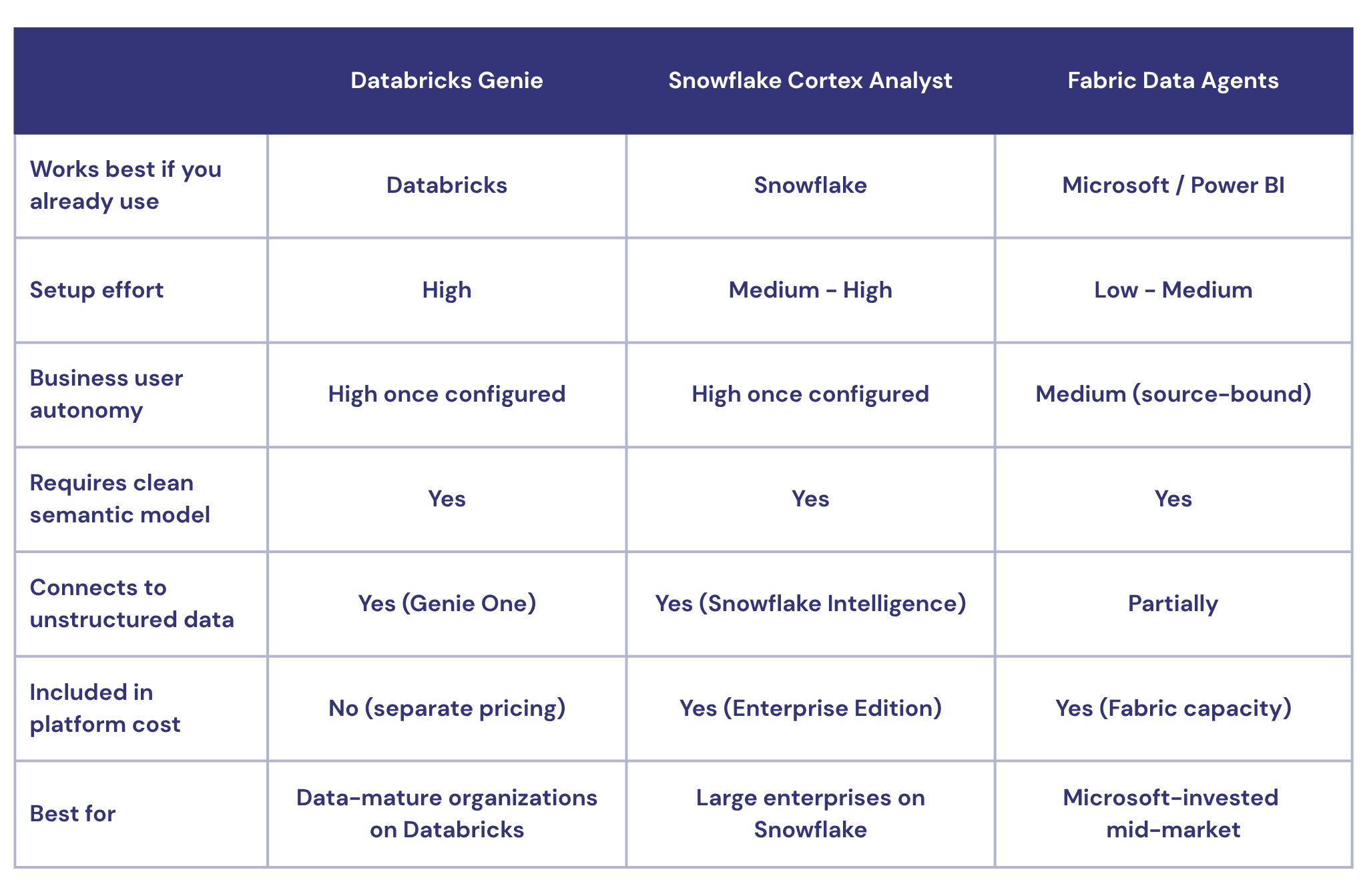
If your data lives in Databricks and you have a data team that can configure Genie Spaces, Genie One is the most capable option in 2026. It handles complexity well, combines structured and unstructured data, and gives business users genuine autonomy once the setup is done.
If you're on Snowflake Enterprise, Cortex Analyst is the natural choice. It's included in your contract, the Teams integration makes it accessible without a new interface, and the semantic model approach is mature and reliable.
If your organization runs on Power BI and Microsoft Fabric, Data Agents are the lowest-friction path. The semantic layer your BI team already built is the foundation the tool needs. The ceiling is somewhat lower than Genie for cross-source queries, but you'll see value faster, and without introducing a new platform.
And if you're not yet deeply committed to any of these platforms, the platform question comes first. Choosing a conversational analytics tool before choosing a data platform is putting the interface before the foundation.
What we see with Belgian clients
A lot of Belgian mid-market organizations we work with fall into the Fabric Data Agents category, for one simple reason: they already use Power BI. The Microsoft investment is already there, the business users know the tool, and Copilot adds a layer on top of something familiar rather than introducing something entirely new.
The Databricks Genie and Snowflake Cortex Analyst conversations tend to happen with larger organizations, or with those that have an existing data engineering practice built on those platforms.
What rarely works well, regardless of tool: rolling out conversational analytics to business teams before the underlying data model is stable. The tool becomes the scapegoat for a data quality problem it didn't create…
That’s why our approach is always to assess the data layer first. If it's ready, picking the right conversational tool takes about thirty minutes. If it's not, we say so and we work on that first.
Explore our next-generation BI practice or get in touch if you'd like an honest read on where your organization stands.
What all three tools do: conversational analytics
All three translate natural language questions into SQL queries against your data, then return a result in plain language or a visualization. The experience looks similar from the outside: you type "what was our gross margin by product line last month?" and something answers.
The meaningful differences sit below that surface:
What data they connect to
How much setup they require
How much they trust the user to interpret results
How deeply they're embedded in your existing stack
Databricks Genie
Genie is Databricks' conversational analytics product, built on top of Unity Catalog, their data governance layer. You set up a "Genie Space", essentially a scoped environment where a data analyst can:
Define which tables and metrics are available
Add business definitions
Configure the guardrails
Business users then ask questions inside that space.
The 2026 version, Genie One, extends this significantly. It can now go beyond the boundaries of a single Genie Space, connect to enterprise knowledge sources like SharePoint and Google Drive, and combine structured and unstructured data in a single response. It also builds and maintains a map of your business automatically, drawing from dashboards, notebooks, and existing pipelines to improve the accuracy of its answers over time.
Who it suits
Organizations already running on Databricks, with a data team that has the time and skill to configure Genie Spaces properly. The tool is powerful, but the setup effort is real. A business user can't just point it at a database and start asking questions. A data analyst has to define the semantic layer first.
Where it falls short
The initial configuration is non-trivial. If your data team is stretched or not particularly familiar with Databricks, Genie will sit unused. It also assumes your data is already in the Databricks lakehouse, which is not the case for many mid-sized Belgian organizations.
Snowflake Cortex Analyst
Cortex Analyst is one product within Snowflake's broader Cortex AI suite. It translates natural language into SQL against your Snowflake data, using a semantic model defined in a YAML file. That semantic model is how the tool understands your business terminology: what "revenue" means, how "active customer" is defined, which tables relate to which.
For Enterprise Edition customers, Cortex Analyst is included at no extra cost. In 2026, it gained native integration with Microsoft Teams and Copilot, and an MCP server connector that allows it to talk to platforms like Salesforce and external agents.
Snowflake Intelligence, the broader product it sits within, extends this to unstructured data. You can upload PDFs, Word documents, or spreadsheets and ask questions across them alongside your structured data: that’s particularly useful for organizations with knowledge spread across documents and databases.
Who it suits
Organizations already on Snowflake, particularly those with a clear semantic model and well-governed data. The Teams integration makes it genuinely accessible for organizations deep in the Microsoft ecosystem who also happen to use Snowflake. It's a strong fit for larger enterprises with both a Snowflake investment and a data team capable of maintaining semantic models.
Where it falls short
Like Genie, Cortex Analyst requires a well-maintained semantic model to give trustworthy answers. Without that, the tool will generate SQL that's technically valid but semantically wrong, for instance a "revenue" figure that doesn't match what the CFO expects. It also requires Snowflake, which is not the default platform for most Belgian mid-market companies.
Microsoft Fabric Data Agents
The right Microsoft equivalent to Genie and Cortex Analyst are Fabric Data Agents. They are specifically built to let business users ask natural language questions directly against governed enterprise data, without writing SQL, DAX, or KQL.
A Fabric Data Agent connects to data stored in OneLake (lakehouses, warehouses, semantic models, and KQL databases) and translates plain-language questions into queries at runtime. The setup follows the same logic as the other tools: a data team defines which data sources are available and governs the semantic layer, then business users ask questions inside that scoped environment.
Microsoft reported up to 50% reduction in end-to-end response times in 2026 for Data Agent workloads against Fabric Data Warehouse, which makes the conversational experience feel genuinely fast rather than a slow query dressed up in a chat interface.
A word on Copilot: Fabric Copilot does something different. It helps analysts build, modify, and navigate Power BI reports through conversation. It's a powerful authoring tool, not a data interrogation tool. The two can work together: Data Agents answer the question, Copilot helps build the report that displays the answer.
Who it suits
Organizations already invested in Microsoft Fabric and Power BI. The semantic layer Power BI already provides (measures, relationships, business context) is what makes Data Agents trustworthy: the groundwork is often already there. Compared to Genie and Cortex Analyst, setup is lower friction for organizations that have already built a clean Power BI semantic model.
Where it falls short
The same constraint as the others: a poorly maintained semantic model produces confidently wrong answers. Data Agents also work within the Fabric ecosystem: if your data sits outside OneLake, extra integration work is needed. And for ad-hoc, exploratory questions that go beyond the defined data sources, Genie's broader scope gives it more flexibility.
A note on pricing
Pricing models differ enough between the three tools that it's worth understanding before you commit.
Databricks Genie moved to a pay-as-you-go model in July 2026. Each user gets 150 free DBUs per month (roughly $10 worth) before billing kicks in. Beyond that allowance, you pay per query. Compute costs (the SQL warehouse running underneath) are on top of this and are often the larger part of the bill. For organizations with heavy, frequent usage, costs can grow quickly and are worth monitoring closely.
Snowflake Cortex Analyst is included in Snowflake Enterprise Edition at no extra charge for the AI query layer itself. You still pay for compute and storage as usual. For existing Enterprise customers, this makes it the most predictable option: you're not adding a new line item, just using what you already pay for.
Microsoft Fabric Data Agents run on Fabric capacity, starting around €250/month for the F2 tier. Agent usage draws on existing capacity units rather than billing separately, though heavy query volumes can increase CU consumption noticeably. As with Copilot, Microsoft recommends measuring usage with a pilot group before enabling broadly.
The pattern across all three: the headline cost is often lower than the real cost once compute, governance setup, and per-query consumption are factored in. The right question to ask your vendor is "what does it cost at our expected query volume, with our data team's time included?"
The thing all three have in common
None of these tools fix bad data. If your sales figures mean different things in different departments, if your KPI definitions aren't agreed, if your data model hasn't been maintained… the chatbot will give you a confident answer that's wrong. Garbage in, garbage out, now delivered faster and with more authority.
This is the part vendors tend to skip in their demos; the setup shown in a product video always assumes clean, well-governed, well-documented data. But most organizations don't start there.
The practical implication: before choosing between these tools, the more useful question to ask is "how clean is our data, and who owns the definitions?" If the answer is unclear, the first investment should be there, not in the conversational layer on top.
Which one is right for your organization?
If your data lives in Databricks and you have a data team that can configure Genie Spaces, Genie One is the most capable option in 2026. It handles complexity well, combines structured and unstructured data, and gives business users genuine autonomy once the setup is done.
If you're on Snowflake Enterprise, Cortex Analyst is the natural choice. It's included in your contract, the Teams integration makes it accessible without a new interface, and the semantic model approach is mature and reliable.
If your organization runs on Power BI and Microsoft Fabric, Data Agents are the lowest-friction path. The semantic layer your BI team already built is the foundation the tool needs. The ceiling is somewhat lower than Genie for cross-source queries, but you'll see value faster, and without introducing a new platform.
And if you're not yet deeply committed to any of these platforms, the platform question comes first. Choosing a conversational analytics tool before choosing a data platform is putting the interface before the foundation.
What we see with Belgian clients
A lot of Belgian mid-market organizations we work with fall into the Fabric Data Agents category, for one simple reason: they already use Power BI. The Microsoft investment is already there, the business users know the tool, and Copilot adds a layer on top of something familiar rather than introducing something entirely new.
The Databricks Genie and Snowflake Cortex Analyst conversations tend to happen with larger organizations, or with those that have an existing data engineering practice built on those platforms.
What rarely works well, regardless of tool: rolling out conversational analytics to business teams before the underlying data model is stable. The tool becomes the scapegoat for a data quality problem it didn't create…
That’s why our approach is always to assess the data layer first. If it's ready, picking the right conversational tool takes about thirty minutes. If it's not, we say so and we work on that first.
Explore our next-generation BI practice or get in touch if you'd like an honest read on where your organization stands.
Ready to reach your goals with data?
If you want to reach your goals through the smarter use of data and A.I., you're in the right place.
Ready to reach your goals with data?
If you want to reach your goals through the smarter use of data and A.I., you're in the right place.
Ready to reach your goals with data?
If you want to reach your goals through the smarter use of data and A.I., you're in the right place.
Ready to reach your goals with data?
If you want to reach your goals through the smarter use of data and A.I., you're in the right place.